Mechanism of generating new words in Sanskrit

We elucidated in the first article of this series that words in Sanskrit represent properties while words in the other languages represent objects. Well, this is not entirely true. Probably, every language has some words that represent properties and some that represent objects. And, Sanskrit is no exception to this. But what separates out Sanskrit is the sheerly enormous ratio of Words representing properties to Words representing objects. Let’s call this ratio X.
X = Words representing properties : Words representing objects then we observe that
a) For most languages: Either X < 1 -OR- X = (approx.) 1 -OR- X (slightly) > 1
b) For Sanskrit: X is of the order of lakhs i.e. X~100000
So, even Sanskrit has words that represent objects. But there quantity is negligible in comparison to the words representing properties. Having noted this, let’s start off with generating new words.
The concept of dhAtu (धातु )
As is the case with derivations everywhere, be it theorems in Maths derived from axioms or chemical formulas derived from elements, the words in Sanskrit are also derived from some basic units. Such elementary, indivisible unit is called a dhAtu. Let’s get to the business right away.
In all, there are 2012 dhAtus in Sanskrit. We shall take up one dhAtu as an example for further illustrations. Let’s take the dhAtu कृ which means to do , make , accomplish , cause , prepare or undertake.
Since कृ is a dhAtu it means that its role in Sanskrit is akin to the role of, say, the element Al(Aluminium) in Chemistry. With Al we can form its oxides, nitrites, sulphides etc. With कृ, we can make its कृदंत words. कृदंत words are those, that can be formed by adding a suffix to a dhAtu. For example, कृ + तव्यत् = कर्त्तव्य| Here कर्त्तव्य is a कृदंत word, तव्यत् is the suffix and कृ is the dhAtu. Given below is a list of (probably) all कृदंत words that can be formed from the dhAtu कृ.
Don’t bother yourself in trying to figure out how to derive these words. They require one to apply certain algorithms to the dhAtu कृ. Describing those algorithms is not in the scope of this series. Take home with youself only the fact that so many words can be directly derived from कृ.
List of कृदंत words derivable directly from कृ
कृत = something that is done = completed or finished
कृतवान = someone who has done
कृति = an object obtained as a result of doing
कर्त्तव्य = something that must be done = duty
करणीय = something that should be done
कार्य = something that can be done = doable
कृत्य = something to be done/accomplished
कर्म = work
कर = something that helps accomplish something = a hand
कार = author, composer, source
कर्ता = doer
क्रिया = activity
करण = something that helps in doing = instrument
कारण = something that makes others do things = reason
करिष्णु = someone/something that constantly keeps doing
कृत्रिम = something that is done/made intentionally = artificial
कार्मुक = a catalyst
कर्मठ = clever and skillful in doing
क्रतु = a blueprint of things that are to be done = a plan
चिकीर्षा = desire to do = enthusiasm
All the above words contain the dhAtu कृ exactly once. These words can be derived using the rules of grammar by adding suffixes to the dhAtu. But this is only the beginning. Let’s look at the more advanced ones.
By combining कृत(something that is done) and कर्त्तव्य(something that must be done), we can generate कृतकर्त्तव्य = someone who has done what he must have done = someone who has performed his duty
Similarly, by combining the other कृदंत words we can form many more complex words.
कृतकरणीय = someone who has done what he should have done
कर्मकार = servant, worker
कृतकृत्य = one who has attained an object or purpose
कारणकर = the cause of the reason
कृतकरण= one who has created an instrument
and so on..
The above words contain the dhAtu कृ exactly twice. Note that there is no limit to how many times a dhAtu can occur in a word.
Let’s look at still more complex ones. The words coming next contain the dhAtu कृ and other dhAtus. The words in the brackets represent the dhAtus that appear in a word.
कृततीर्थ = one who has visited holy places = (कृ) + (तृ)
कृतज्ञ = one who acknowledges past services or deeds = (कृ) + (ज्ञा)
कृतमार्ग = one who has made a road or path = (कृ) + (मृग्)
कृत्यशेष = one who has left incomplete, the task he intended to do = (कृ) + (शिष्)
कृतदेश = one whose place is fixed = (कृ) + (दिश्)
कृतकाल = one who has a commitment at a particular time = (कृ) + (कल्)
कृतव्रत = one who has taken a resolution = (कृ) + (वृ)
कृतिसाध्यत्व = the property of being accomplished by exertion = (कृ) + (साध्)
वृक्षकृतालय = one who has made his house on a tree = (व्रश्च्) + (कृ) + (ली)
लोकक्षयकृत् = one who destroys the world = (लोक्) + (क्षी) +(कृ)
कृतोद्वेगनाद = one who makes sounds due to agitation or excitement = (कृ) + (विज्) +(नद्)
and so on…
As I pointed out earlier, there are 2012 dhAtus in all. But these are the primary dhAtus only. By adding suffixes to a dhAtu, we have formed कृदंत words above. By adding prefixes to a dhAtu, we can form new dhAtus! For example, प्र + कृ = प्रकृ. Similarly we can have दुःकृ, उपकृ, कुकृ, निकृ, उत्कृ, सुकृ, विकृ, संकृ, आकृ, निःकृ, परिकृ, अवकृ, पराकृ, अभिकृ, अधिकृ, अपिकृ, अतिकृ, प्रतिकृ, अपकृ, अनुकृ | And now, the above process of generating कृदंत words and then combining them to form still more complex words, can be initiated from each of these new dhAtus just as it was initiated from कृ ! That is, we can generate 1000’s of words from this dhAtu कृ alone.
Now let’s look at some gems from mahAbhArata and rAmAyaNa.
जानु = knee | बाहु = arm | आजानुबाहु = one whose arms reach upto his knees
पद्म = lotus | पत्र = petal | अक्ष = eye => पद्मपत्राक्ष = one whose eyes are like lotus petals
चर = something that moves | अचर = something that does not move => सचराचर = something having both moving and stationary parts
आदि = beginning | मध्य = middle | अन्त = end => अनादिमध्यान्त = something having no beginning, no middle and no end
व्यक्त = expressed or manifested | आदि = beginning => अव्यक्तादि = something that is not manifested in the beginning
सर्व = everything | भूत = any physical object | भव = the complete existence | उद्भव = source => सर्वभूतभवोद्भव = one who is the source of all the physical objects and the complete existence (Notice that the dhAtu भू appears 3 times in this word!)
भगवत् = a glorious person/object | गीता = sung => भगवद्गीता = something sung by a glorious person
सूर्य = sun | कोटि = crore | सम = same | प्रभ = effulgence => सूर्यकोटिसमप्रभ = one whose effulgence is equivalent to that of a crore suns.
….and this process has no end….
Shri Rama is also called AjAnubAhu, since his arms reached upto his knees!

Shri Rama is also called AjAnubAhu, since his arms reached upto his knees!
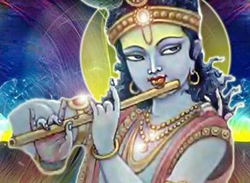
Shri Krishna is also called padmapatrAkSa, since his eyes were similar to lotus-petals. Can you now guess, how did we get the 1000 names of viSNu in viSNu-sahasranAma ?
Q) This is superb! I am really impressed. This mechanism of forming new words is not complex. In fact, it is very simple. And this causes a sort of uneasiness in me. Take, for instance, पद्मपत्राक्ष which when translated to English would become LotusPetalEye. This is meaningless in English. Or as another example, take सूर्यकोटिसमप्रभ which when translated to English would become SunCroreEquivalentEffulgence. Again meaningless in English. Then, why do these compound words have meanings in Sanskrit ? Why can’t this simple mechanism of generating new words be used in English ?
Shri Krishna is also called padmapatrAkSa, since his eyes were similar to lotus-petals. Can you now guess, how did we get the 1000 names of viSNu in viSNu-sahasranAma ?
A) The question you have asked is bang on target. I say this because to answer it we need to comprehend the concept of विभक्ति, which is the single main reason for all the sophistication that Sanskrit possesses. One can not even think of learning Sanskrit without grasping the essence of विभक्ति, and this is what we will try to do in the next article. That would be the climax of this series.
You have asked many questions so far, including those in part 1. Now, let me ask you one for testing what you grasped so far.
Q) We have seen that the most basic unit in the Sanskrit word generating mechanism is called a धातु. If you have some knowledge of Hindi, you might know that, in Hindi, metal is also called धातु . Can you guess why so ?
A) Hmm. Probably because there is some property which is common to both. Wait! I think, it is because both a metal and the smallest unit of Sanskrit Grammar can be modified and molded into different forms to generate new objects. We have seen that a dhAtu can be used to generate new words by varying its form. Similarly, even a metal can me molded into different shapes to form new objects. Right ?
Yes, you are correct. So now I can say that you have really grasped the essence of the series so far. 😛
By the way, stay tuned for the next article where we would introduce the concept of विभक्ति and explain why Sanskrit is probably the shortest among all languages.
1 comment
Sign in with Google to join the conversation.
Sign in to comment
Jevgenijs Сernihoviсs