Temporal order of words in Sanskrit

In the article Similarities between Sanskrit and Programming Languages, we translated the sentence मूर्खः परिहर्तव्यः प्रत्यक्षः द्विपदः पशुः। There we showed that this sentence conveys the existence of a single person who has 5 properties viz. he is stupid, he must be avoided, he is located in front of the eyes, he has two legs and he is an animal. But we never discussed about which among the 5 properties comes first. In other words, how do we decide which of the following translations is the most accurate ?
- A stupid person must be avoided. He is like a two-legged animal in-front of the eyes.
- The one who is in front of eyes having two legs is animal, stupid and avoidable.
- One having two legs in front of eyes is a stupid animal and should be avoided.
To answer this question and decide whether option 1 or 2 or 3 is the correct translation, we shall first understand the classification of Sanskrit words according to derivability and usage. We give that classification below.
There are 3 types of words in any Sanskrit sentence viz. योग, रूढ and योगरूढ.
योग words
योग words are those that are derivable from more basic entities and can be used to represent any object. For example, समविभक्ताङ्ग = one whose parts are symmetrically distributed. This word is a योग, because it is derivable from 3 more basic entities viz. सम + विभक्त + अङ्ग and it can be applied to any object which has symmetrically distributed parts. In Ramayana, this word is used to describe श्री राम because his body was symmetrical. But this word can also be used to describe a sunflower, because a sunflower’s petals are spread out radially/symmetrically from its center.
Similarly, we have तुल्यप्रियाप्रिय = someone who behaves uniformly in favorable as well as unfavorable situations. This word occurs in Gita and is used by Krishna to describe the qualities of an ideal human being. This is a योग word because it is derivable from 3 more basic units viz. तुल्य + प्रिय + अप्रिय and can be used for any person with that quality.

Krishna explains to arjun that one who becomes joyful in favorable situations and distressed in unfavorable situations does not attain mokSa.
Note that both समविभक्ताङ्ग and तुल्यप्रियाप्रिय can be splitted into other words and not dhAtus. A word derived this way by compounding 2 or more words (and not dhAtus) is called a समास.
But words can also be derived directly from dhAtus. The general form of a word derived directly from dhAtus is उपसर्ग + धातु + प्रत्यय। For example, a word that is derived directly from the dhAtu भज् is विभक्त. It is derived as follows. वि (उपसर्ग) + भज् (धातु) + क्तवत् (प्रत्यय) are combined. Then some algorithms are applied to this combination of उपसर्ग + धातु + प्रत्यय to generate the word विभक्त. (These algorithms were designed by maharSi pANini and can be found in aStAdhyAyI). Similarly, another word derived directly from dhAtu is प्रिय. प्री (धातु) + यत् (प्रत्यय) are combined and then some algorithms are applied to the combination to generate प्रिय. To summarize, योग words fall in 2 categories. (1) Those derived from other words (समास) and (2) those derived from dhAtus (कृदन्त). योग words are infinite in number and we do not require a dictionary for them. They form the bulk of Sanskrit literature.
समासयोग words
समविभक्ताङ्ग = सम + विभक्त + अङ्ग
तुल्यप्रियाप्रिय = तुल्य + प्रिय + अप्रिय
परोत्सवनिजोत्सव = पर + उत्सव + निज + उत्सव = one who considers a happy occasion for others as a happy occasion for himself
सर्वतःपाणिपाद = सर्वतः + पाणि + पाद = one whose hands and legs emerge from everywhere
कृदन्तयोग words (derived by applying Panini’s algorithms)
विभक्त = वि + भज् + क्तवत्
प्रिय = प्री + यत्
अतुल्य = न + तुल् + यत्
Note that संधि is NOT a mechanism of forming new words. More on संधि in a later article.
रूढ words
रूढ words are those that are not derivable and represent a fixed object. Examples are given below.
कर्पास = cotton (कपास in hindi)
निम्ब = neem tree (नीम in hindi)
स्याल = wife’s brother (साला in hindi)
These words are not derivable and can only be used to represent fixed objects. They are finite in number and we require a dictionary for them.
योगरूढ words
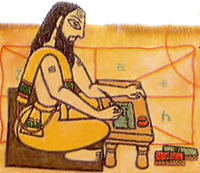
maharSi pANinI has described algorithms that can be applied to dhAtus and other basic units to generate complete Sanskrit. He has written his aStadhyAyi as a sequence of instructions that can be used to form the algorithms. He was the first person to describe grammar in the form of a computer-program. Only that his program was never compiled by a machine. But the program works and has no errors!
योगरूढ words are those that are derivable but are used to represent only a few objects. For example, संसार = something that keeps changing in all possible ways. Though there are many objects to which this word applies, but in Sanskrit literature, this word has always been used to denote the world.
Similarly, वृक्ष = something that is cut down. Though this word can apply to many objects, in Sanskrit literature, this has always been used to represent either a tree or the trunk of a tree. Again, if a योगरूढ word is derived from dhAtus, then it is called कृदन्तयोगरूढ word and if it is derived from other words then it is called समासयोगरूढ word. Below are some examples.
कृदन्तयोगरूढ words (derived by applying Panini’s algorithms)
सागर = स + गॄ + अ = one which can swallow anything => used to denote a sea or an ocean or a big snake
संसार = सम् + सृ + अ = something that keeps changing in all possible ways => used to denote the world
समासयोगरूढ words
भास्कर = भाः + कर = something that creates light => used to denote the sun or gold
पङ्कज = पङ्क + ज = one which grows in wet mud => used exclusively for lotus
These words, though finite, are lakhs in number and there meaning can be guessed approximately without a dictionary, but a dictionary is necessary to find out the exact meaning.
So how does this knowledge of योग, रूढ and योगरूढ words help in translating the sentence मूर्खः परिहर्तव्यः प्रत्यक्षः द्विपदः पशुः | ? To understand this, we need to grasp the concept of विशेष्य and विशेषण.
विशेष्य – विशेषण
In a sentence, विशेष्य is any word which denotes an object whose qualities are being described in the sentence. And the words used to describe those qualities are called विशेषण.
For example, consider the sentence भारिणी शिला लुण्ठति | which means A heavy rock rolls down. (भारी शिला लुढ़कती है | in hindi). Here, शिला is the word which denotes an object viz. rock, whose quality viz. heaviness is being described by भारिणी| Hence, शिला is विशेष्य and भारिणी is विशेषण in this sentence. As a general rule of thumb, in any sentence, रूढ and योगरूढ words are विशेष्य and योग words are usually विशेषण. Hence, the knowledge of योग, रूढ and योगरूढ words helps in identifying the विशेष्य and विशेषण in a sentence. But, why is identifying विशेष्य and विशेषण important ?
The notion of विशेष्य and विशेषण is important because of two very basic rules of grammar. Below I give those rules.
Rule1: In any sentence, a विशेषण has the same विभक्ति, लिंग and वचन as the विशेष्य. So if विशेष्य belongs to first vibhakti, स्त्रीलिंग and एकवचन then the विशेषण should also belong to first vibhakti, स्त्रीलिंग and एकवचन |
Hence, भारी (पुल्लिंग) शिला (स्त्रीलिंग) लुण्ठति | is incorrect, while भारिणी (स्त्रीलिंग) शिला (स्त्रीलिंग) लुण्ठति | is correct. That is because the (विशेषण) भारिणी and (विशेष्य) शिला should have the same विभक्ति, लिंग and वचन |
Rule2: If a विशेषण comes immediately before विशेष्य then it means the विशेष्य already has the quality being described by विशेषण, while if the विशेष्य comes immediately before विशेषण then it means that the sentence is informing the reader that the quality described by the विशेषण is there in the विशेष्य.
Example of this rule is give below.
सुन्दरः बालः। means A cute boy (exists) while बालः सुन्दरः | means that The boy is cute.
भारिणी शिला | means A heavy rock (exists) while शिला भारिणी | means that The rock is heavy.
Summary of the rules
- In a sentence, रूढ and योगरूढ words are विशेष्य and योग words are usually विशेषण.
- In a sentence, a विशेषण has the same विभक्ति, लिंग and वचन as the विशेष्य.
- If a विशेषण comes immediately before विशेष्य then it means the विशेष्य already has the quality being described by विशेषण, while if the विशेष्य comes immediately before विशेषण then it means that the sentence is informing the reader that the quality described by the विशेषण is there in the विशेष्य.
Finally, let’s translate मूर्खः परिहर्तव्यः प्रत्यक्षः द्विपदः पशुः | in a step-by-step manner.
1) Identify the योग, रूढ and योगरूढ words.
2) मूर्ख is a रूढ word because it has no derivation and has a fixed meaning.
3) पशु is a योगरूढ word because it has a derivation, but is exclusively used to denote an animal. पशु = पश् + उ = one which is tethered.
4) परिहर्तव्य, प्रत्यक्ष and द्विपद are योग words because they have a derivation and can be used to denote unknown new objects.
परिहर्तव्य = परि + हृ + तव्यत्
प्रत्यक्ष = प्रति + अक्ष
द्विपद = द्वि + पद
5) From the rule we stated above, मूर्ख and पशु are विशेष्य because they are रूढ and योगरूढ, while परिहर्तव्य, प्रत्यक्ष and द्विपद are विशेषण because they are योग words.
6) Because मूर्ख and पशु are विशेष्य, the sentence is describing the qualities of मूर्ख and पशु.
7) Because परिहर्तव्य, प्रत्यक्ष and द्विपद are विशेषण, we know that they are being used to describe the qualities of मूर्ख and पशु.
8) It should be understood from the context and sequence of words in the sentence that परिहर्तव्य is denoting the quality of मूर्ख while प्रत्यक्ष and द्विपद are denoting the qualities of पशु.
9) Hence the sentence can be broken down into two parts viz. मूर्खः परिहर्तव्यः and प्रत्यक्षः द्विपदः पशुः|
10) Each part contains one विशेष्य.
मूर्खः परिहर्तव्यः = A stupid person must be avoided.
प्रत्यक्षः द्विपदः पशुः = A two-legged animal in front of the eyes (exists).
Since मूर्ख and पशु have the same vibhakti, they denote the same object. Hence the sentence translates to A stupid person must be avoided. He is like a two-legged animal in-front of the eyes. Hence, option 1 above is the correct translation.
In fact, a sentence typically contains one or more विशेष्य. Each such विशेष्य has one or more विशेषणs describing the qualities of the respective विशेष्य. An easy way of translating a sentence is to split it into groups of विशेष्य and विशेषण, with each group containing one विशेष्य. In the above example, the groups were मूर्खः परिहर्तव्यः and प्रत्यक्षः द्विपदः पशुः |
Note that to split the sentence into groups, we have relied on guessing the plausible meaning. This may not always be clear though. So to eliminate any potential confusion, the sentence मूर्खः परिहर्तव्यः प्रत्यक्षः द्विपदः पशुः। can also be written as
- मूर्खः परिहर्तव्यः। सः प्रत्यक्षः द्विपदः पशुः।or as
- यः मूर्खः सः परिहर्तव्यः सः प्रत्यक्षः द्विपदः पशुः।
However, in चाणक्यनीति, आचार्य चाणक्य prefers मूर्खः परिहर्तव्यः प्रत्यक्षः द्विपदः पशुः over the other 2 versions.
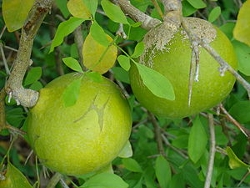
Each bael leaf (बिल्व) is divided into three leaflets.
Exercise: Translate the following sentence. Identify the विशेष्य and विशेषण in it.
त्रिदलं त्रिगुणाकारं त्रिनेत्रं त्रिधायुतं त्रिजन्मपापसङ्हारं एकबिल्वं शिवार्पणम्।
That’s it for now. Bye.

Comments
No comments yet. Be the first to share a reflection.