Introduction for Sentence Diagrams

Our thoughts have a form. That form has a spine. Grammarians allude to that spine when they talk about subject-predicate but don't show it. Sentence Diagrams do.
Some words and some relationships among words are indispensable to the expression of the intended thought while others are not. These special words, like the predicate verb and subject, constitute the spine of a clause. The clause is further fleshed out by hinging other words upon the words of this spine. Without the words constituting the spine the clause falls apart and is no more capable of holding the intended thought.
For example:
It was the hour before the Gods awake.

And for
And Savitri too awoke among these tribes
That hastened to join the brilliant Summoner’s chant
And, lured by the beauty of the apparent ways,
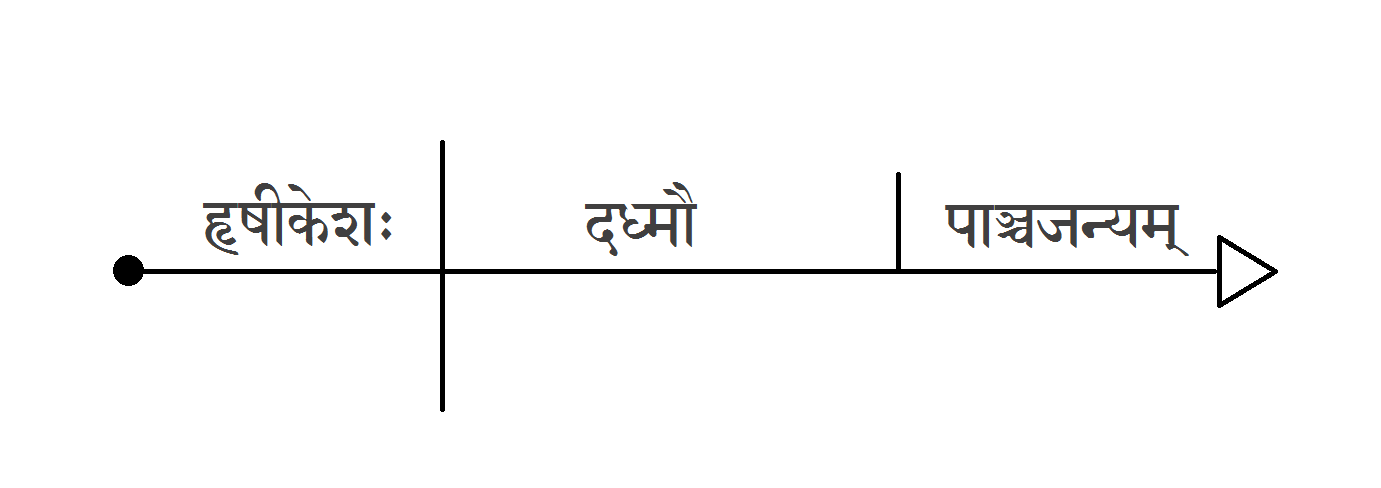
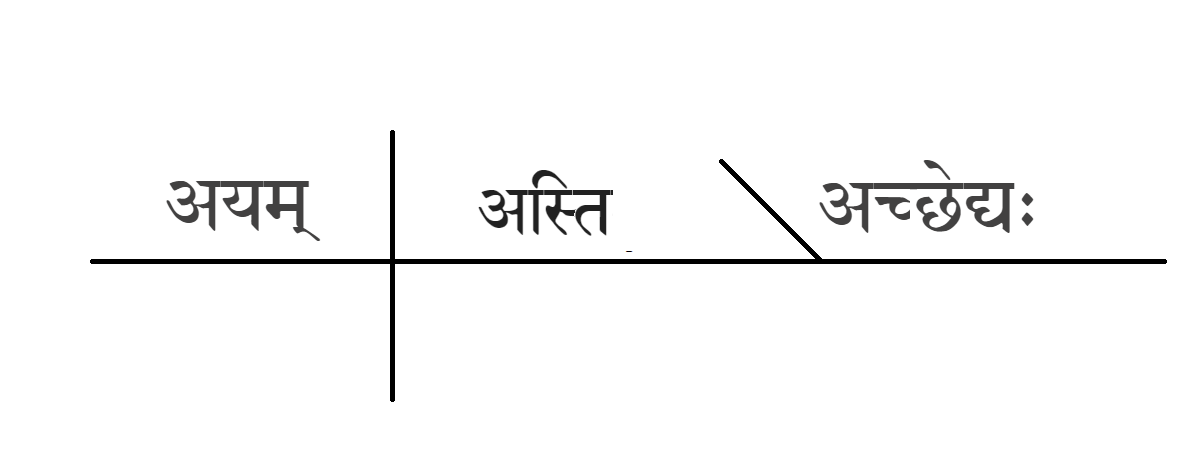
Acclaimed their portion of ephemeral joy.

The most popular diagramming system for English was developed by Reed and Kellogg in the late nineteenth century. But can that scheme be adapted for Sanskrit?
Sanskrit as a language is much more systematic and efficient than others and therefore can lend itself for any systematic approach at diagramming its clauses. It would be helpful to note the general context that Sanskrit is essentially developed and optimised to be a language of inner life and its development--the language of conscience, of yoga, of spirit. English on the other hand is developed and optimised to be a language of material life and its development. This objective-orientation of English results into words being intimately married to the material and physical reality while the subjective-orientation of Sanskrit results into words being eternally married to the sense-idea of sounds. English starts with an ever-expanding collection of words of which some must somehow come together to achieve the unity of a thought. Sanskrit starts with the unity of experience which the words must spontaneously manifest and elaborate.
English sentence is built from 8 independent parts of speech (POS) (a division based on functional roles). For Sanskrit words the building blocks trace their origin to a single entity called "dhatus". Dhatus themselves are unique combinations of consonant sounds latched on to any one of the principal vowel sounds. They carry a "sense" or a "sense-idea", eternally native to a sound, that arises spontaneously/ naturally in our consciousness. These "dhatus" are further dressed up through suffixes, infixes and prefixes through one or many stages to result into "padams"--verbal or noun words or others. A general path from "dhatu" to "padam" could be generalised as--root sense to sense-idea to a linking-idea to objective form fit for sentence-use. To be usable in a sentence as nouns the words must be vibhaktified—they must be declined.
From a functional perspective there is a way to tag Sanskrit words in a sentence in four(?) functional roles. Nouns-Adjectives-Pronouns are a single category of pointers to the same object (Vibhaktified Participles too fall in this category though they don't point to the same object but they imply, but not assert, the same object as the subject of the participle's verb-form); Verbs; Prefixes which modify the verbs and nouns; and indeclinables which can play the role of conjunctions or adverbs or as participles. Now there are some vibhaktified words which function as adverbs. Such a use is to be understood in context of Karakas. Karakas form the fundamental conceptual structure (CS) of a sentence while the sentence with padams is a form of thought that is expressed from the relative perspective, vivaksha, of the utterer. Therefore by diagramming the hidden CS of a sentence we can hope to explore the sentence to depths that are not systematically available for English sentence diagrams.The difference between Karakas and Vibhaktis need to be thoroughly contemplated for a proper appreciation of thought and its expression.
1 . The Sanskrit sentence diagramming therefore must begin with the CS of the main clause:
Example of CS where numbers indicate the Karka (Note that here only stems of padams are used and not padams):
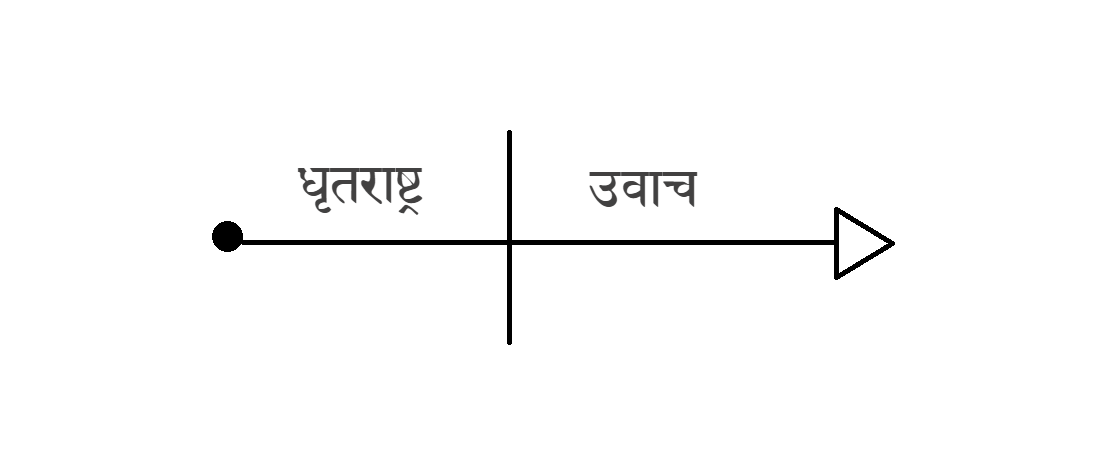
धृतराष्ट्र उवाच
Dhritarashtra said
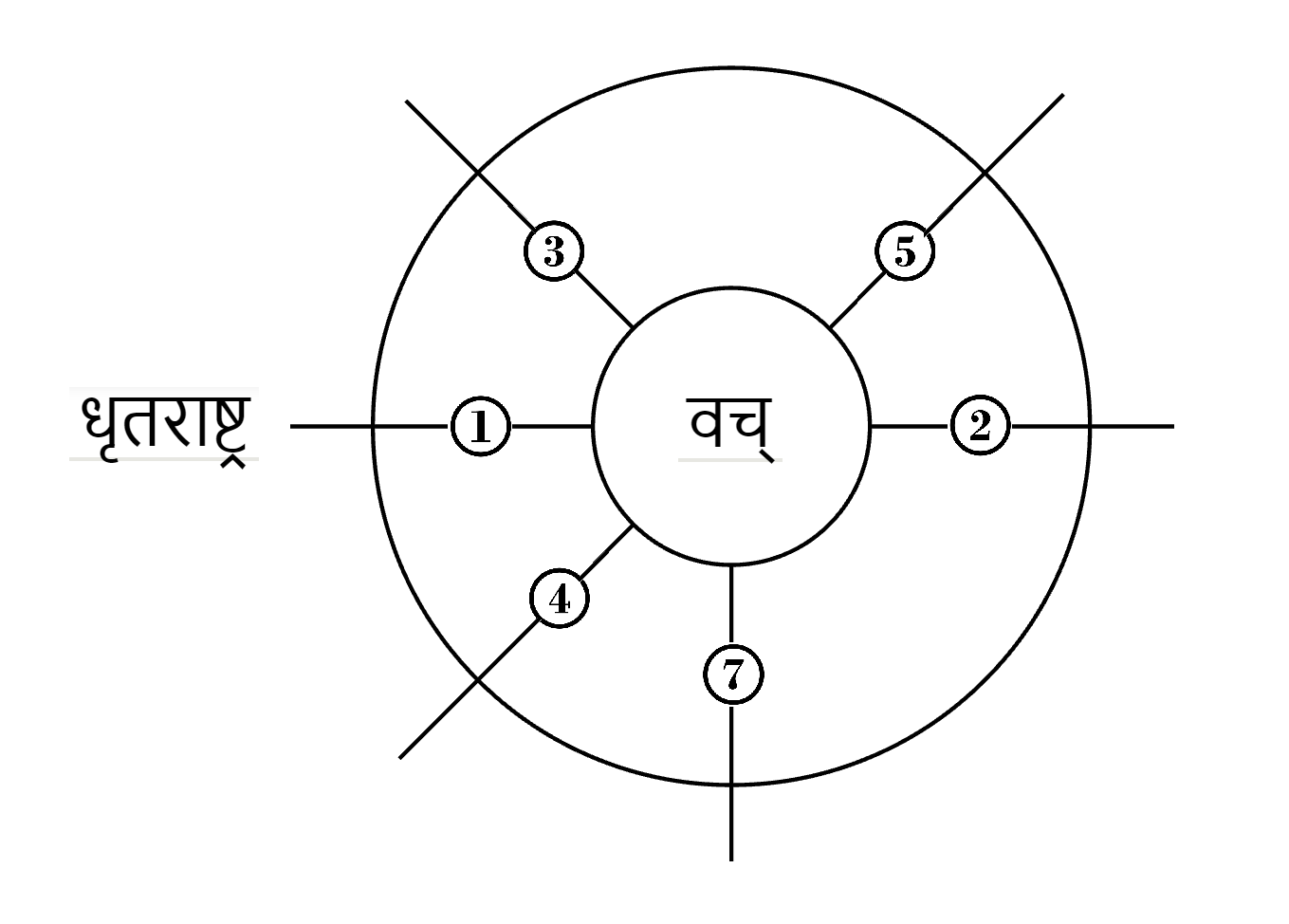
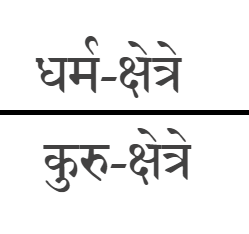
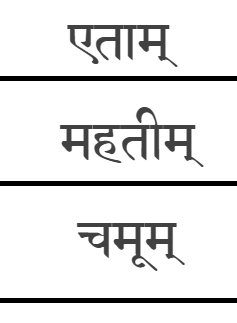
2 . 'All words in a clause with the same vibhakti generally point to the same object' (with a few exceptions where vibhaktified words are playing an adverbial role or in case of twin objects which both are declined in the second vibhakti etc.) is the single most important rule in sentence construction in Sanskrit. Therefore all words with the same vibhakti will be stacked one on top of another rather than as adjectives diagrammed as angular modifiers. For example:
धर्म-क्षेत्रे कुरु-क्षेत्रे
On the field of Kurukshetra, the field of the working out of the Dharma
and:
एताम् महतीम् चमूम्
this mighty host
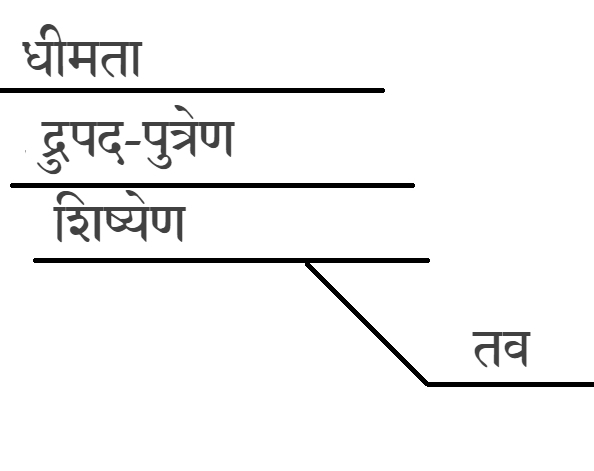
3 . The sixth vibhakti of Sambandh or Genitive is diagrammed by a modifying angular line to the main noun by the possessive:
"तव" धीमता शिष्येण, द्रुपद-पुत्रेण
Drupada’s son, "thy" intelligent disciple
4 . One could even say that there are no adjectives in Sanskrit in the way that English has. All the vibhaktified words of same vibhakti enjoy similar status and are pointers to the same object with the only distinction in cases of temporal relevance being as explained below in 5.
5 . Temporal order of words in a clause is only relevant to the extent of the order of 3 types of words in any Sanskrit sentence viz. योग, रूढ and योगरूढ. And obviously the words of the same clause or phrase must be together to the extent that they do not introduce any ambiguity.
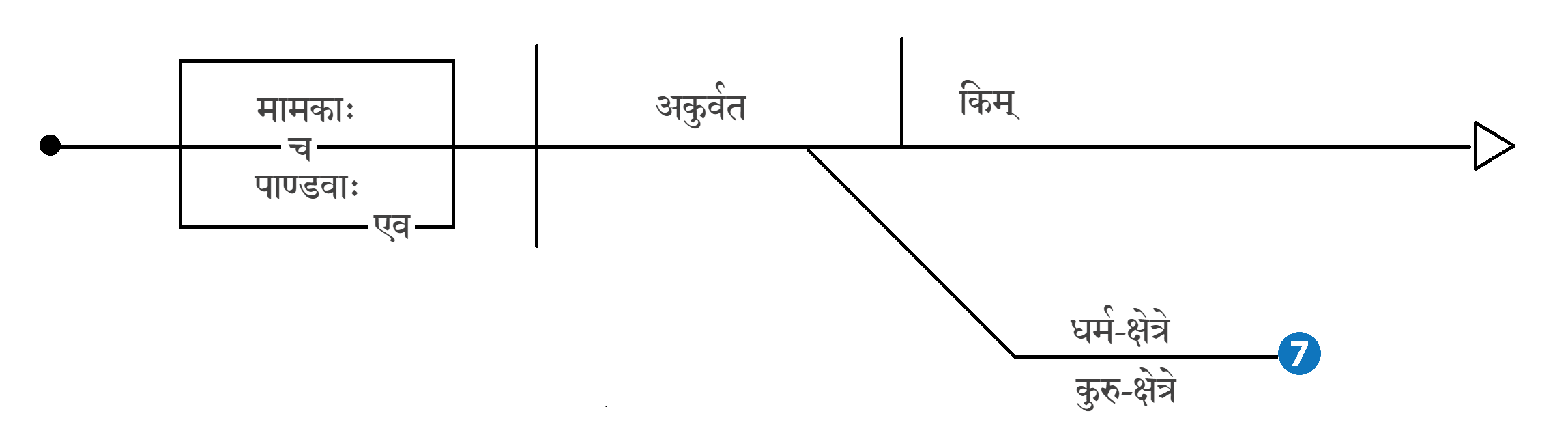
6 . Vibhaktis other than sixth act like qualifiers of the verb and are therefore plotted as branches emanating from the verb. Below is the diagram for the Locative or the seventh Vibhakti branching from the verb अकुर्वत:
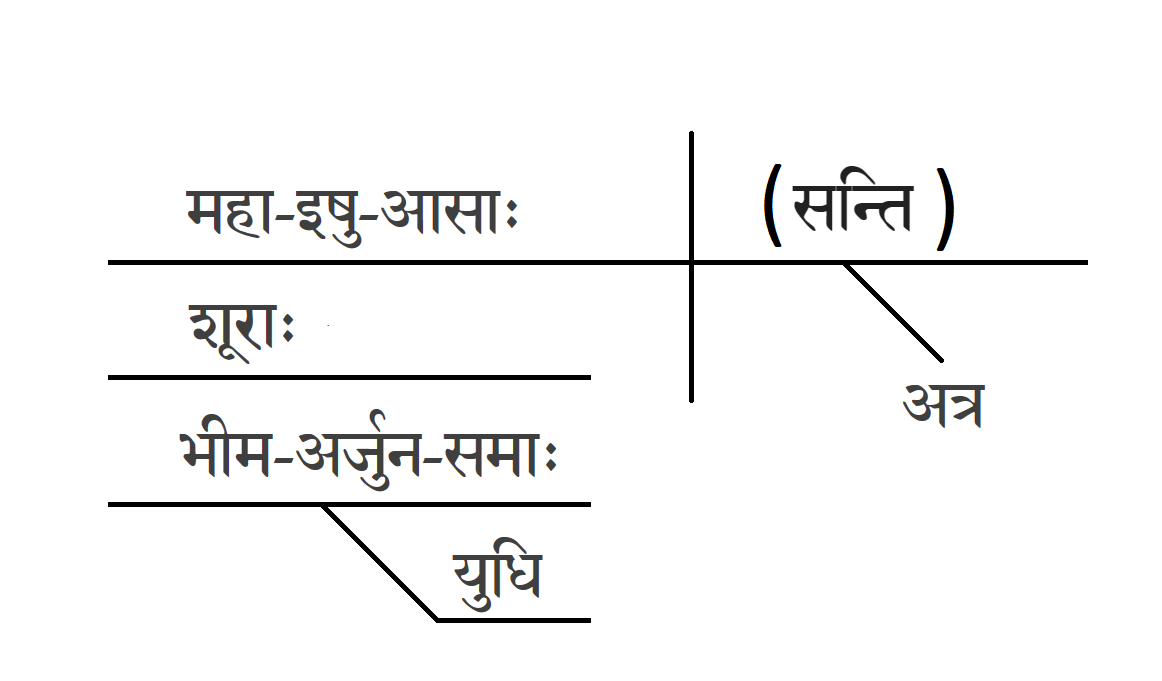
7 . Sanskrit is efficient and economical language. Therefore, the redundant words are not expressed at all. They are implicitly present in the sentences. For the purposes of Sentence Diagrams we would be supplying all the implicit words to make the structure totally explicit. For example the bracketed words supply the implied words:
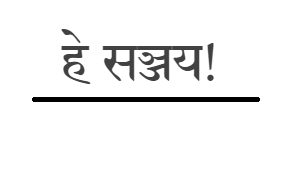
8 . The interjections would be diagrammed as floaters like in English Sentence diagrams. Example:
9 . With this background we can start with the "spine" (could also be called the "action-line" in the limited sense of active constructions) or the "story-line" of an independent clause (the basic unit of a complete human thought). The words of this line tells the crux of the entire story of the clause while all the other words flesh the other relevant details. The subject-predicate line of action where either the subject acts upon the object or itself (active construction shown with an arrow pointed from left to right); or the object is acted upon by the subject (passive construction where arrow is shown pointed from right to left) where transitive verb is involved; or the predicate is merely a complement of the subject along with the linking verb; or the bhava construction in case of intransitive verbs where the verbal action is the central element of perception (is like a passive construction for intransitive verbs).
subject | predicate
10 . subject | verb | object
11 . subject | linking-verb \ subject-complement
(The line slanted towards the subject indicates that the subject-complement refers to the subject.)
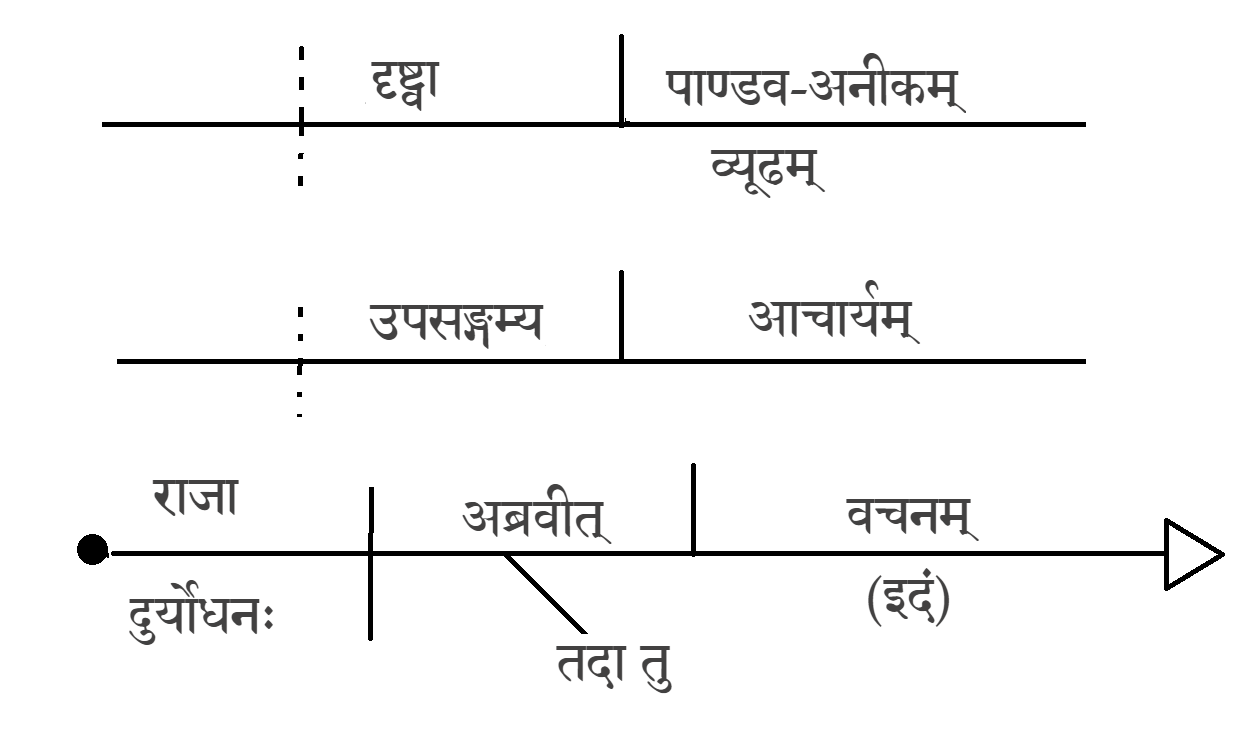
12 . All participles are vertically aligned to the implied subject:
तदा तु राजा दुर्योधनः "व्यूढम् पाण्डव-अनीकम् दृष्ट्वा", "आचार्यम् उपसङ्गम्य", (इदं) वचनम् अब्रवीत्
Then the prince Duryodhana, "having seen the army of the Pandavas arrayed in battle order", "approached his teacher" and spoke these words

Comments
No comments yet. Be the first to share a reflection.