गुणत्रयविभागयोगः
guṇatrayavibhāgayogaḥ
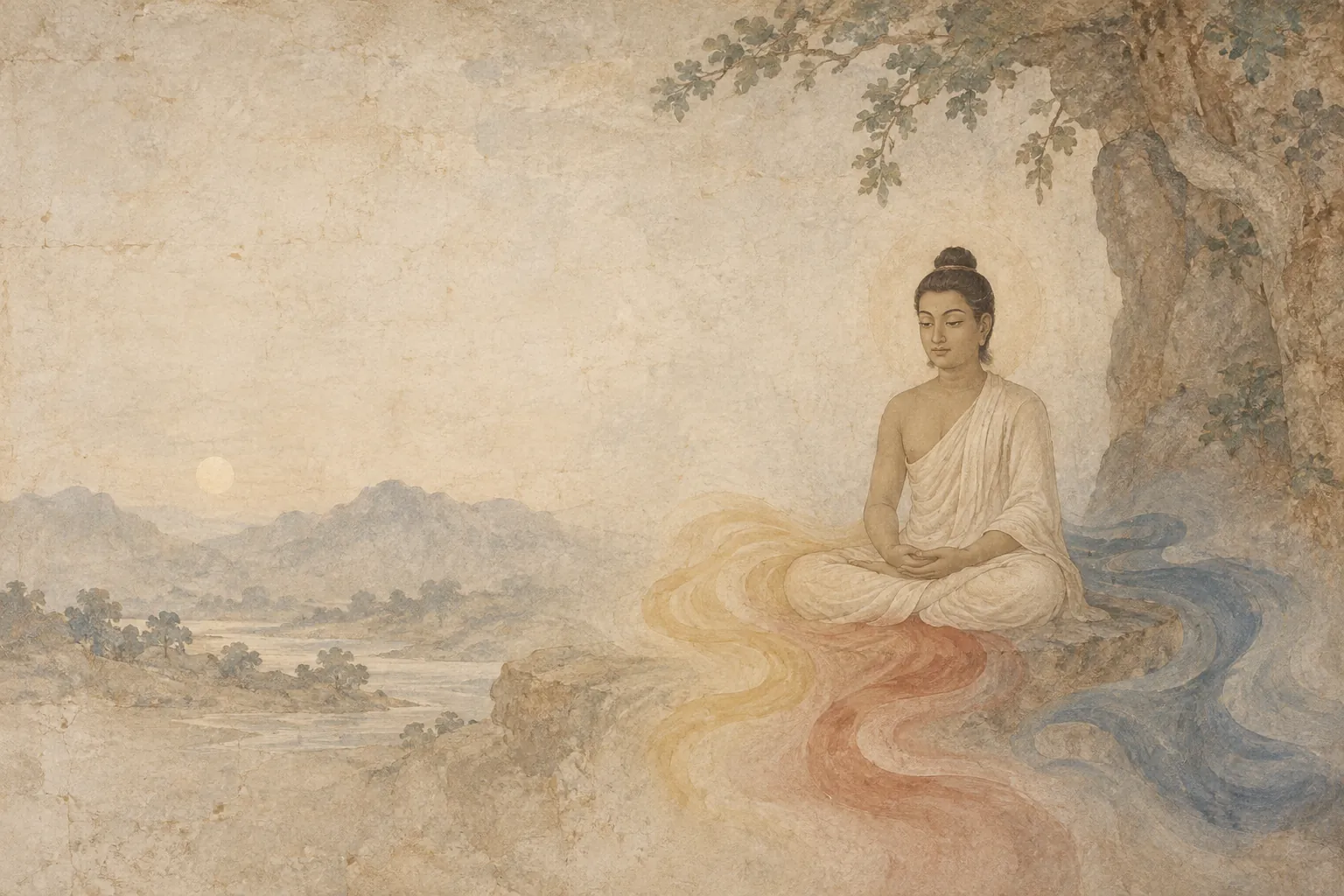
Rise like the sun above the clouds of the three modes, and let an undeviating love carry you beyond them into the foundation that is the Purushottama.
- kṣetrajña — the Knower who sees, yet still bound by the strands of the Field
- guṇātīta — the soul risen above the three modes, founded in the Purushottama
The thirteenth chapter distinguished the Knower from the Field; the fourteenth shows the cords by which the Field holds him. Krishna announces again the supreme knowledge, by which the sages have become “of like nature and law of being” with him and are not troubled even by the dissolution of the worlds (14·1–2). Sri Aurobindo makes this likeness, sādharmya, the key of the whole chapter, a capital point, as he calls it, in the teaching of the Gita.
That liberation, that oneness, that putting on of the divine nature … it declares to be the very essence of spiritual freedom and the whole significance of immortality.
The Eternal is Father and Mother of the worlds: into the vast of the Mahat Brahman he casts the seed, and thence all beings spring (14·3–4). But in the lower Nature the soul is bound by three modes, sattva, rajas and tamas, which “bind in the body the imperishable dweller in the body” (14·5). Sattwa is light and happiness, and when it rises there comes a flooding of light into all the doors of the body (14·6, 14·11); rajas is the thirst of liking and longing, the unrest of desire and seeking impulsion (14·7, 14·12); tamas is inertia, negligence and the sleep of the mind (14·8, 14·13). Now one leads, now another (14·10). The subtle point, which Sri Aurobindo presses, is that even sattwa binds, by attachment to knowledge and to happiness (14·9); for its light is still a mental light, and other is the infinite spiritual knowledge and the free self-existent delight of our spiritual being.
How then shall the soul go free, when all action is the action of the modes? Not by ceasing to act, but by seeing: “When the seer perceives that the modes of Nature are the whole agency and cause of works and knows and turns to That which is supreme above the gunas,” he attains to the divine being (14·19–20). Arjuna asks for the marks of such a man (14·21), and the answer is equality: he does not abhor the rising of light or of impulsion or of dimness, nor long for them when they cease (14·22); gold and mud and stone are of one value to him, and praise and blame, friend and foe (14·24–25); he is seated as one high above, knowing that it is only the gunas that move (14·23).
He has seated himself in the conscious light of another principle than the nature of the gunas and that greater consciousness remains steadfast in him, above these powers and unshaken by their motions like the sun above clouds to one who has risen into a higher atmosphere.
Yet this is still a double status, Sri Aurobindo observes: a free spirit in the immutable Brahman watching an unliberated Nature. Is that division the last word? The chapter’s closing verses answer with the note to which the Gita always returns. “He also who loves and strives after Me with an undeviating love and adoration, passes beyond the three gunas” (14·26); and this “Me” is the foundation of the silent Brahman, of immortality, of the eternal dharma and of an absolute bliss (14·27).
There is a highest spiritual experience and foundation above the immutability of the Brahman, there is an eternal dharma greater than the rajasic impulsion to works … there is an absolute delight which is untouched by rajasic suffering and beyond the sattwic happiness, and these things are found and possessed by dwelling in the being and power of the Purushottama.
So the soul leaves this threshold poised above the modes like the sun above the clouds, and yet not resting in a mere witness-calm; for love has pointed past the silent Self to Someone who is its foundation. That Someone has been spoken of as “I” from the first chapter to this. On the next threshold he will be named.
Essays on the Gita
Key verses
