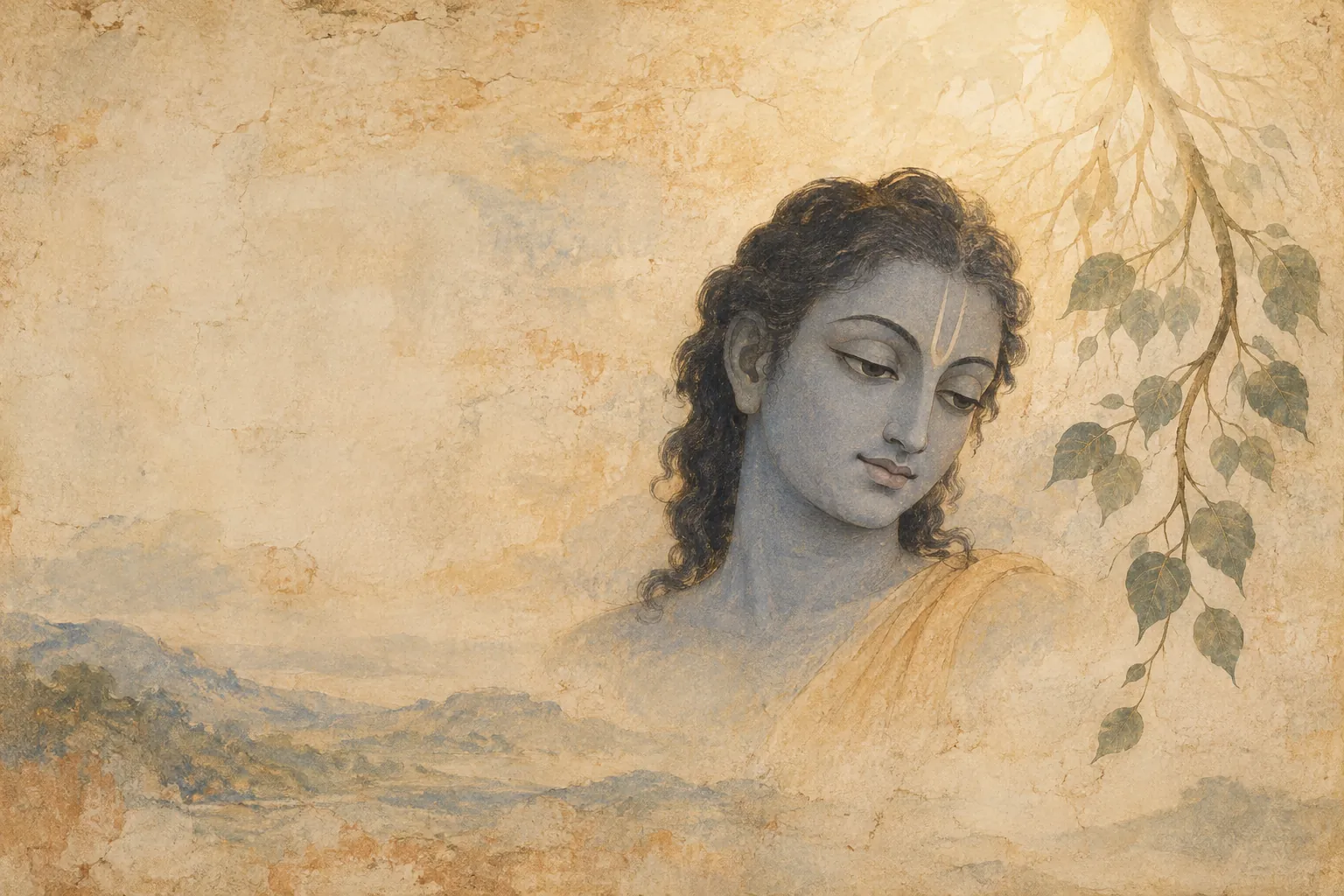
पुरुषोत्तमयोगः
puruṣottamayogaḥ
Cut the downward roots of desire with the sword of detachment, and find above the world-tree the Supreme Person, who is the light of sun and moon and the flame of life in every heart.
- guṇātīta — the soul free above the modes, on the verge of a greater mystery
- puruṣottama — the Supreme who exceeds the mutable and the immutable, adored with the whole being
The fourteenth chapter ended with an “I” who is the foundation even of the silent Brahman; the fifteenth gives that I its name. Sri Aurobindo says that the whole doctrine of the Gita, through all its balancing of systems and reconciliation of experiences, has been converging on this one thought, and that the idea of the Purushottama, prepared and assumed from the beginning, is only now expressly stated and illuminated by a name.
This central thought is the idea of a triple consciousness, three and yet one, present in the whole scale of existence.
The chapter begins with the ancient image of the Aswattha, the cosmic tree with its original source above and its branches stretching below, nourished by the gunas, its secondary roots of attachment and desire plunged down into the world of men (15·1–2). Its real form cannot be seen here; it must be cut by the strong sword of detachment, and that original Soul sought from whom the ancient urge of action streamed forth (15·3–4). Free from bewilderment and ego, desires stilled, the duality of joy and grief cast away, the soul reaches the timeless being not lit by sun or moon or fire (15·5–6). But if that were all, Sri Aurobindo asks, where would be the call to action, the slaughter of Kurukshetra, the million-bodied Lord and his high-voiced bidding to arise?
The answer is one of the most consequential lines of the poem: “It is an eternal portion of Me that becomes the Jiva in the world of living creatures” (15·7). The individual soul is no illusion and no passing knot of ego; it is a real and eternal portion of the Divine, mamaivāṃśaḥ sanātanaḥ.
For it means that each soul, each being in its spiritual reality is the very Divine, however partial its actual manifestation of him in Nature.
This soul takes up a body and goes forth from it as the wind takes perfumes from a vase (15·8); the deluded do not see him, but those who are formed in the spirit behold him (15·10–11). And the same Divine is seen everywhere sustaining the world from within: the light of the sun and moon and fire (15·12), the might that upholds the earth and the Soma that nourishes the plants (15·13), the flame of life that digests the food of creatures (15·14), and the presence lodged in the heart of all, from whom are memory and knowledge and their absence (15·15).
Then the crown. There are two Purushas in the world, the mutable, which is all these existences, and the immutable, the unmoved Self above them (15·16); but other than these two is the highest Spirit who enters the three worlds and upbears them (15·17), beyond the mutable and higher even than the immutable, proclaimed in the world and the Veda as the Purushottama (15·18). Sri Aurobindo calls this verse the keyword of the Gita’s reconciliation of the two apparent opposites of our existence. He who knows him so adores him with all-knowledge and in every way of his being (15·19).
Divine in the equality of his imperturbable self-existence, one in it with all objects and creatures, he brings that boundless equality, that deep oneness down into his mind and heart and life and body and founds on it in an indivisible integrality the trinity of divine love, divine works and divine knowledge. This is the Gita’s way of salvation.
“Thus by Me the most secret Shastra has been told, O sinless one” (15·20). The soul has reached the summit of vision: it knows the One who is silence and action, self and world, and loves him with all its being. Yet it must still live and work in a nature of the gunas. The next threshold descends from the peak to that nature, to the two kinds of beings and to the choice that lies within them.
Essays on the Gita
Key verses
