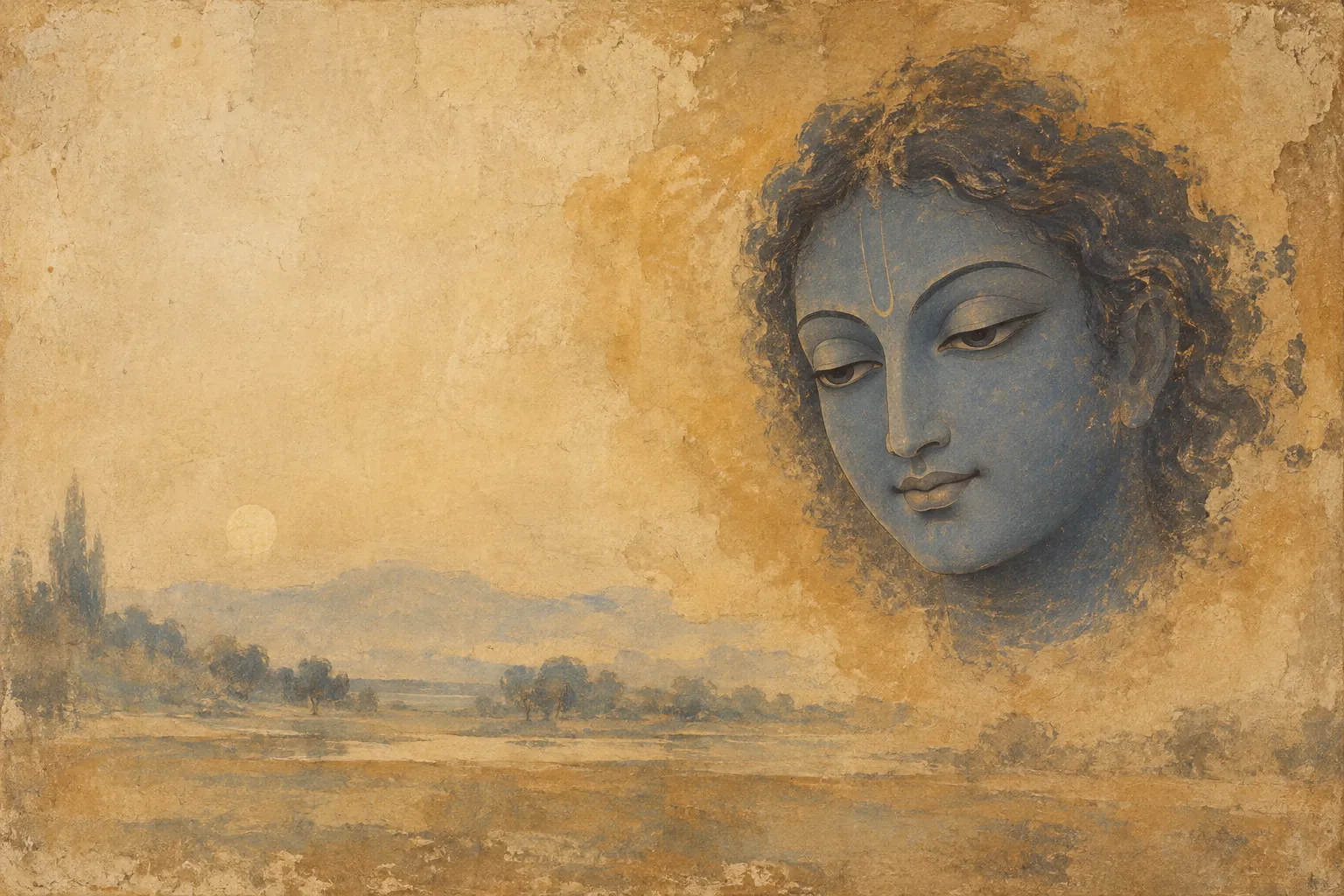
क्षेत्रक्षेत्रज्ञविभागयोगः
kṣetrakṣetrajñavibhāgayogaḥ
Know the body and the mind with all their motions as a field, and know the one Lord who is the Knower in every field, seated equally in all, unperishing within the perishing.
- madbhaktaḥ sa me priyaḥ — the lover dear to God, who must now know Soul and Nature
- kṣetrajña — the Knower in all fields, the one Lord seen seated equally in every being
With the thirteenth chapter the Gita enters its last movement. The lover who is dear to God has been shown the way; now the ground of that way must be laid bare in a clear and complete knowledge. In this edition the chapter opens with Arjuna’s own question, heard as its first verse: he would learn of Prakriti and Purusha, of the Field and the Knower of the Field, of knowledge and the object of knowledge (13·1). Sri Aurobindo explains why the question is put here. Having dwelt first on the immutable self and then on the Lord and the One in all beings, the Gita must now bring out the precise relations between the supreme Purusha, the immutable self, the Jiva, and Prakriti with her gunas, if the soul is to rise out of the lower into the divine nature.
“This body, O son of Kunti, is called the Field,” the answer begins, and that which takes cognizance of it is the Knower of the Field (13·2). But the body here is the whole working of the lower Nature, mind and sense and ego and all their movements, and the chapter at once enlarges the Knower beyond the individual: “Understand Me as the Knower of the Field in all Fields, O Bharata; it is the knowledge at once of the Field and its Knower which is the real illumination and only wisdom” (13·3). The constitution of the field is given briefly in the terms of the Sankhya (13·6–7), and among its deformations are pleasure and pain, liking and disliking. Here Sri Aurobindo lets a single sentence open a whole psychology.
From the Vedantic point of view we may say that pleasure and pain are the vital or sensational deformations given by the lower energy to the spontaneous Ananda or delight of the spirit when brought into contact with her workings.
Then, where the mind expects a treatise, the Gita gives a portrait. What it calls knowledge is a character: absence of pride, harmlessness, a candid soul, a long-suffering heart, purity, steadfastness, reverence for the Teacher, detachment from the objects of sense, freedom from egoism, equality to all happenings, a mind turned to solitude, and an unswerving devotion (13·8–12). Sri Aurobindo reads these as the marks of the man whose soul is turned towards the inner wisdom, the conditions of knowledge rather than its information. One knows the Eternal by becoming of a kind that can receive him.
The object of that knowledge is now described in words that strain the reason on purpose. His hands and feet are on every side of us, his faces are those innumerable visages we see wherever we turn (13·14); he is without senses yet all the senses reflect him, unattached yet all-supporting (13·15); the inward and the outward, the far and the near, the moving and the unmoving, all this he is (13·16); indivisible, he seems divided in creatures (13·17); light of all lights, he is seated in the heart of every being (13·18).
When man sees this eternal and universal Godhead within himself, when he becomes aware of the soul in all things and discovers the spirit in Nature, when he feels all the universe as a wave mounting in this Eternity and all that is as the one existence, he puts on the light of Godhead and stands free in the midst of the worlds of Nature. A divine knowledge and a perfect turning with adoration to this Divine is the secret of the great spiritual liberation.
Soul and Nature are both without origin (13·20); Nature is the doer, the individual soul the enjoyer, drawn by her qualities into births good and evil (13·21–22). But seated in this body is the Supreme Soul, witness, source of the consent, upholder, enjoyer, almighty Lord (13·23). The true seeing follows: “Seated equally in all beings, the supreme Lord, unperishing within the perishing – he who thus sees, he sees” (13·28); seeing him so, one does not injure oneself by oneself (13·29), and one knows that all action is done by Prakriti while the Self is the free witness (13·30). As the one sun illumines the whole earth, so the Lord of the Field illumines the whole Field (13·34).
The disciple leaves this threshold having learned to stand back and see, the field no longer mistaken for the self, the same Lord recognised in every creature. But the field is still woven of three strands whose knots he has not yet undone; the next threshold names them and shows the way above them.
Essays on the Gita
Key verses
