अर्जुनविषादयोगः
arjunaviṣādayogaḥ
Before the Word can be spoken the old law must fail, and in the silence of that failure the Charioteer is already holding the reins.
- dharma — the settled law of the outer man, confident in its standards
- viṣāda — the dejection in which every standard fails and the soul turns to the Friend
The Gita does not open in a forest hermitage or in the calm of a teacher’s house but upon a field of war, and the first word of the poem names that field with a double name: Kurukshetra, and also dharmakṣetra, the field of the working out of the Dharma (1·1). The soul stands here at the summit of its outward confidence. Arjuna has lived by the noblest law he knew, the law of the chivalrous fighter who protects the right and beats down lawless violence, and that law has carried him, step by step and with a good conscience, to this plain where the armies are drawn up. The conchs are blown, the Panchajanya of Krishna among the rest (1·14–15), and nothing yet tells that the one who blows it is more than a comrade in arms. It is in pride and not in doubt that Arjuna asks his charioteer to stay the chariot between the two hosts, that he may look upon those whom he has to meet “in this holiday of fight” (1·21).
But it is the Charioteer who sets the chariot in its place, and the sight he gives is not the sight Arjuna asked for. Where he looked for the champions of unrighteousness he sees teachers and grandsires, uncles and sons, comrades and kinsmen (1·26); and the war for justice becomes suddenly a war upon all that the social man holds dear and sacred. The crisis does not begin in the mind. It comes, as Sri Aurobindo observes in The Human Disciple, through the sensations, like a blow at the very centre of the sensational, vital and emotional being: the limbs fail, the mouth is parched, the great bow Gandiva slips from the hand (1·28). Then the vital aims of action fall away, victory and kingdom and enjoyment (1·31), and last the moral sense rises to justify the revolt, pleading the ruin of the family, sin and hell (1·36–44).
It is the sensational, emotional and moral revolt of the man hitherto satisfied with action and its current standards who finds himself cast by them into a hideous chaos where they are in violent conflict with each other and with themselves and there is no moral standing-ground left, nothing to lay hold of and walk by, no dharma.
This is not the recoil of a coward, nor the questioning of a philosopher. Arjuna is the pragmatic man of action, sattwic in his temper, governed by high and clear principles, and precisely because his standards were high their collapse is complete; the law of the warrior, the law of the family and the law of compassion now command contrary things, and the intelligence that knew only these laws has nowhere left to stand. Yet the chapter bears the name of a Yoga, the Yoga of the dejection of Arjuna, and the name is not ironical. In Kurukshetra Sri Aurobindo reads this dejection as the discouragement of the human being who is forced to face the spectacle of the universe as it really is, with the veil of the ethical illusion torn from his eyes, before a higher reconciliation with himself has been effected. The field of battle is the type of all world-existence; and the soul that has seen it without a veil can no longer rest in a merely human rule of right.
God is not only the Destroyer, but the Friend of creatures; not only the cosmic Trinity, but the Transcendent; the terrible Kali is also the loving and beneficent Mother; the lord of Kurukshetra is the divine comrade and charioteer, the attracter of beings, incarnate Krishna.
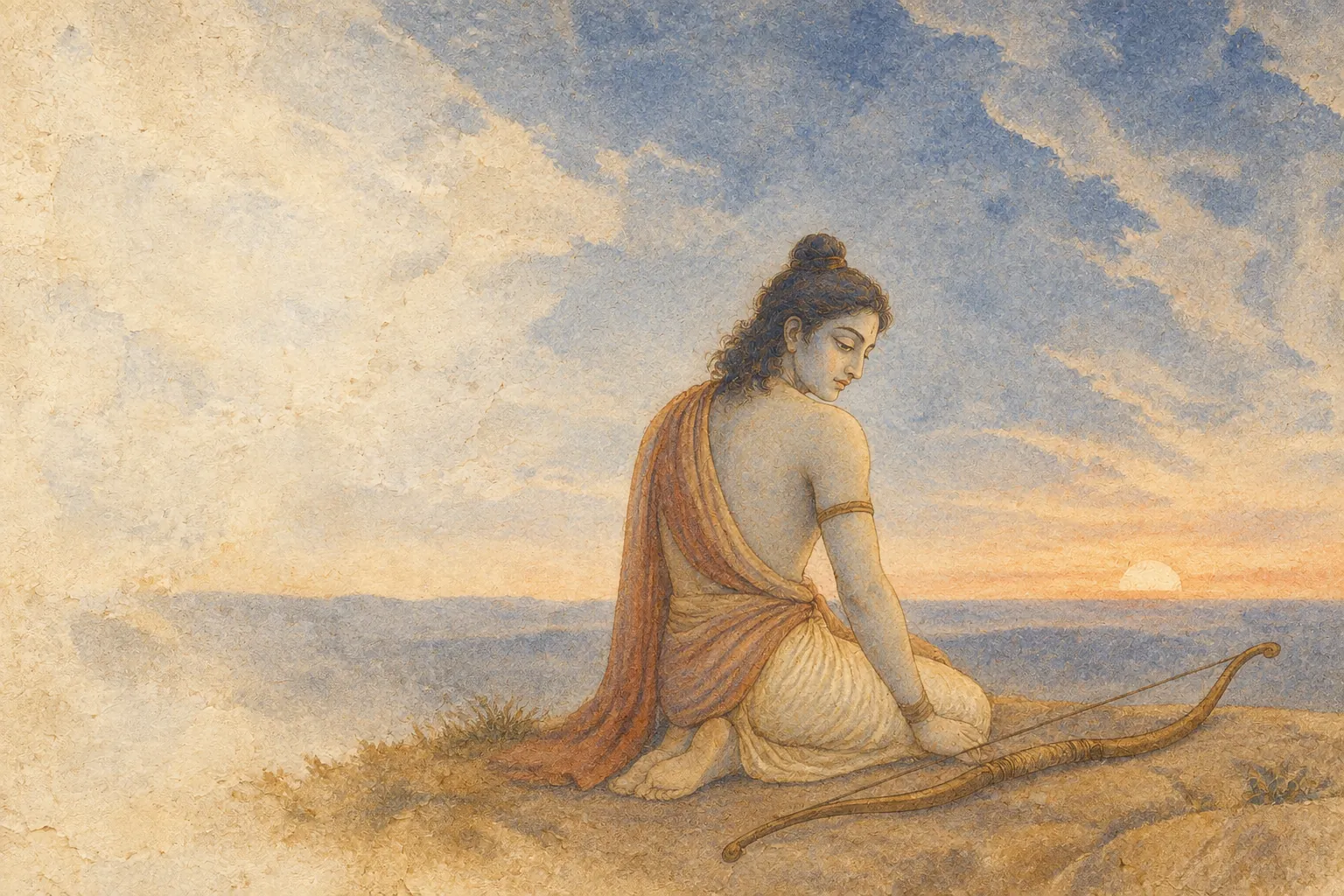
So the chapter closes upon an emptied soul. Arjuna declares that it is better to be slain unarmed and unresisting than to fight (1·45), and he sinks down upon the seat of the chariot, casting away the divine bow and the inexhaustible quiver, his spirit overwhelmed with sorrow (1·46). The Teacher has not yet spoken a single word. But the silence is full. The disciple has come, through the very bankruptcy of his standards, to the one condition in which a greater Word can be received; he will ask only for a dharma, a rule by which to walk again, and he will be given something he did not know how to ask for, the secret of living consciously in the Divine and acting from that consciousness. Beside him in the chariot, holding the reins of the horses he has himself forgotten, sits the one who will lead him there, and behind the conch that has sounded for battle there is already, for the ear that can hear it, the music of the flute.
Essays on the Gita
Key verses
