आत्मसंयमयोगः
ātmasaṃyamayogaḥ
Lift the self by the Self, still the mind like a lamp in a windless place, and in that stillness find the One who is never lost to you.
- brahmanirvāṇa — the ego extinguished in the Brahman, and the Brahman found all about the soul
- śraddhāvān bhajate — the inmost self given to the Divine in love and faith
The peace of the Brahman has been shown; now it must be won and made constant, and the sixth chapter turns to the discipline of the inner being. It begins by sealing the reconciliation already made: whoever does the work to be done without resort to its fruits, he is the Sannyasin and the Yogin, not the man who lights no sacrificial fire and does no works (6·1). For the sage who is climbing the hill of Yoga, action is the means; for the same sage when he has reached the top, calm is the means (6·3); and he has reached it when he is attached neither to the objects of sense nor to works and has renounced all will of desire in the mind (6·4). Then comes the great word of self-mastery: by the self thou shouldst deliver the self, for the self is the friend of the self and the self is its enemy (6·5).
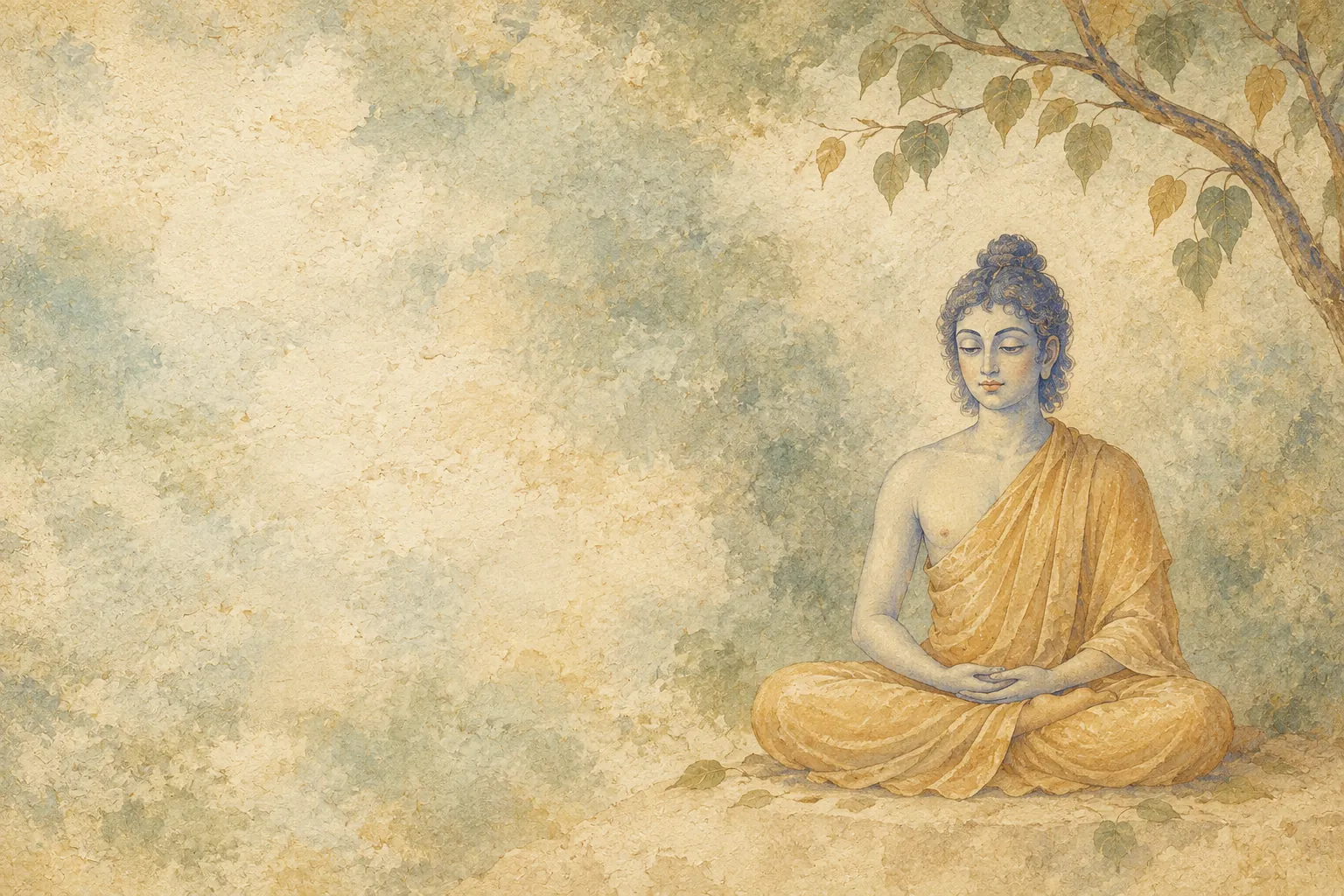
The Teacher describes the practice of meditation with a gentle exactness: the Yogin seated apart, desire and the idea of possession banished (6·10), the consciousness motionless like the light of a lamp in a windless place (6·19). Yoga is defined here as the divorce of the mind’s marriage with grief, the firm winning of an inalienable spiritual bliss (6·23). It asks no violence against the body; it is not for one who eats or sleeps too much, nor for one who gives up food and sleep (6·16), but all must be yukta (6·17). Sri Aurobindo reads the word in a double sense: first as measure, and then, when the Yoga is attained, as union, so that in waking and in sleep, in food and play and action, all is done in the consciousness of the Divine.
The fruit is a vision in which the world is not lost but found again. The Yogin sees the self in all beings and all beings in the self (6·29); and then, in one of the tenderest promises of the Gita, the Divine speaks in the first person: he who sees Me everywhere and sees all in Me, to him I do not get lost, nor does he get lost to Me (6·30). He who has taken his stand upon oneness and loves Me in all beings, however he lives and acts, lives and acts in Me (6·31).
But to see God in the world is to fear nothing, it is to embrace all in the being of God; to see all as the Divine is to hate and loathe nothing, but love God in the world and the world in God.
Arjuna, honest as always, protests that the mind is restless, vehement and strong, as hard to hold as the wind (6·34); and Krishna does not deny it, but answers that it is controlled by constant practice and non-attachment (6·35). What then of the one who strives and falls short? Here the Teacher’s voice grows most intimate: neither in this life nor hereafter is there destruction for him, for never does anyone who practises good, O beloved, come to woe (6·40). No sincere step is lost; the soul takes up its ascent again in a new birth, drawn on by its former aspiration.
And so the first six chapters close upon a word that looks beyond them. The Yogin is greater than the doers of askesis, greater than the men of knowledge, greater than the men of works; become then the Yogin (6·46). But of all Yogins, he who with all his inner self given up to Me, for Me has love and faith, him I hold to be the most united with Me in Yoga (6·47). The discipline of works and knowledge has been laid down, and at its very crown the name of love is spoken.
It is this that is the closing word of these first six chapters and contains in itself the seed of the rest, of that which still remains unspoken and is nowhere entirely spoken…
Essays on the Gita
Key verses
