मोक्षसंन्यासयोगः
mokṣasaṃnyāsayogaḥ
Abandon all dharmas and take refuge in the Beloved alone; he will deliver thee from all sin and evil: grieve not, and rejoice again and again.
- oṃ tat sat — sacrifice, gift and askesis offered to the Real
- mām ekaṃ śaraṇaṃ vraja — refuge in the Divine alone, and a delight that rejoices again and again
The last chapter gathers the whole Gita into itself. It opens with Arjuna’s last question, on sannyāsa and tyāga (18·1), and the answer settles a confusion that Sri Aurobindo saw running through the later Indian mind: sacrifice, gift and askesis are never to be given up, for they purify the wise (18·5); what is renounced is attachment and the fruit (18·6, 18·9). The real Tyaga has action and living in the world as its basis. Then, in a searching analysis, the chapter shows the five causes of every work, the fifth of which is a Power beyond the human (18·14); the ego that thinks itself the sole doer does not see (18·16); and knowledge, action, doer, reason, persistence and even happiness are shown in their three kinds (18·20–39), up to that sattwic happiness which is poison at first and nectar in the end (18·37). Beyond even that, Sri Aurobindo points, lies the Ananda from which all things are born.
Now the teaching turns to svabhāva and svadharma, the inner law of each nature and the work that springs from it (18·41–44). Sri Aurobindo reads the fourfold order by its spiritual kernel, the soul of knowledge, of power, of mutuality, of works and service in every being, and not by the later rigidity of birth. The decisive word is worship: by his own work a man worships Him from whom all beings originate and by whom all this is pervaded, and so reaches perfection (18·46); better one’s own law, though imperfect, than an alien law well wrought (18·47).
Then in a few verses the whole Yoga is restated. The unattached understanding reaches the perfection of inner quietude (18·49), and the soul becomes the Brahman (18·50–53). But this, Sri Aurobindo insists, is the base and not the summit: “When one has become the Brahman… then one gets the supreme love and devotion to Me” (18·54); by devotion he knows Me, who and how much I am, and enters into That (18·55); and by doing all actions lodged in Me he attains the eternal status (18·56). Knowledge, works and love here become one movement. The Lord is seated in the heart of all beings turning them on the wheel of Maya (18·61); in him take refuge with all thy being (18·62).
The secret has been told, and the more secret; now the most secret of all is spoken, because Arjuna is beloved (18·63–64). “Become my-minded, my lover and adorer… to Me thou shalt come, this is my pledge and promise to thee, for dear art thou to Me” (18·65). “Abandon all dharmas and take refuge in Me alone. I will deliver thee from all sin and evil, do not grieve” (18·66). Sri Aurobindo reads this not as lawlessness but as the Gita breaking out of its own great structure into the liberty of the spirit.
An ineffable Ananda will take up our petty joy and sorrow, our struggling pleasure and pain, cast away their discordances and imperfect rhythms … and transform all into its transcendent and universal unimaginable delight.
“Destroyed is my delusion,” Arjuna answers, “I have regained memory through Thy grace” (18·73). The warrior who let fall his bow in the first chapter now takes it up, no longer as the ego but as the instrument.
Destroyed is the illusion of the mind; the soul’s memory of its self and its truth concealed so long by the misleading shows and forms of our life has returned to it and become its normal consciousness
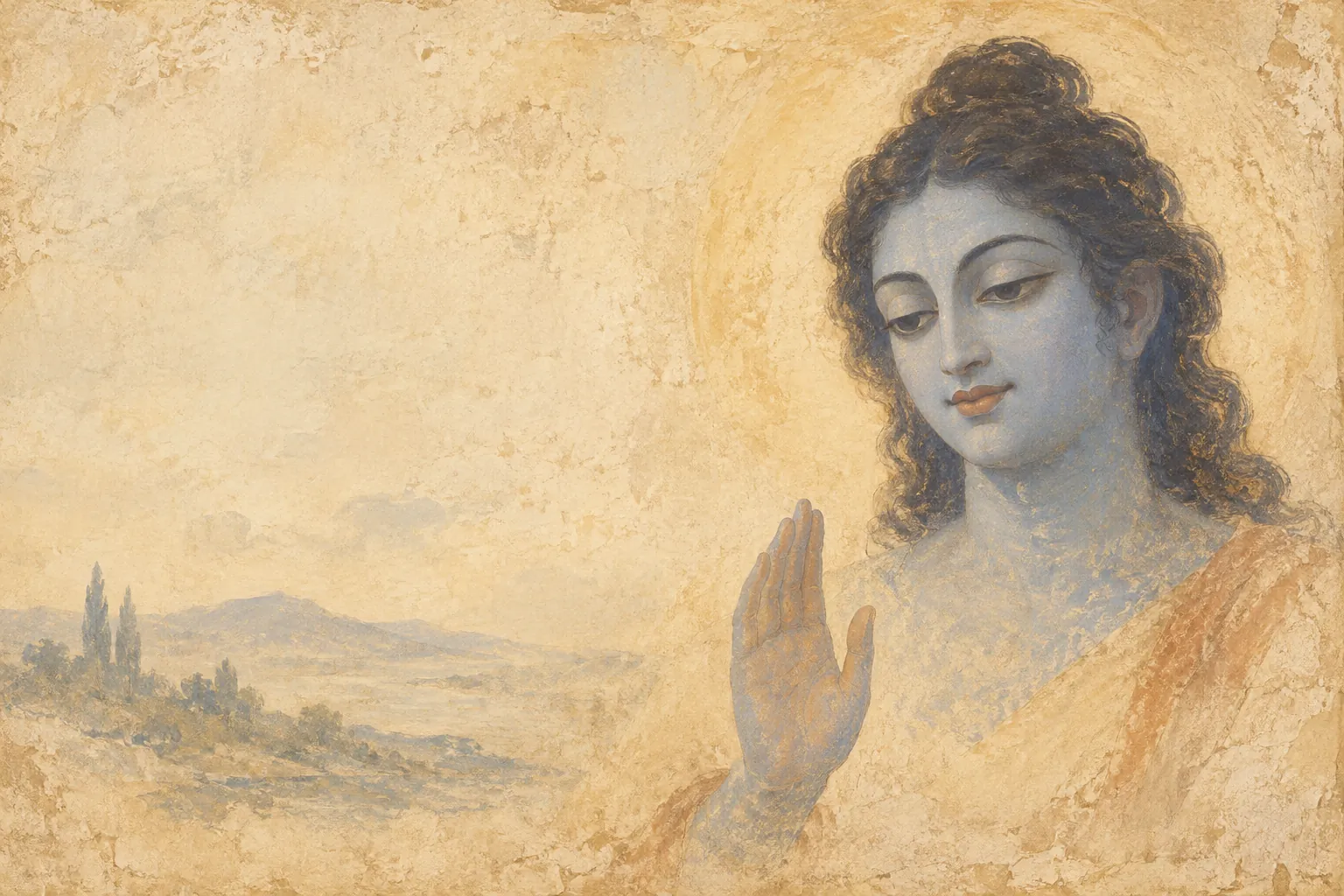
And then the voice that opened the poem speaks once more. Sanjaya, who by the grace of Vyasa has heard this supreme secret from Krishna himself (18·74–75), cannot contain his wonder: “Remembering, remembering this wonderful and sacred discourse of Keshava and Arjuna, I rejoice again and again” (18·76); remembering that most marvellous form of Hari, great is his wonder, and again he rejoices (18·77). The Gita that began in the grief of a man ends in the delight of the one who has heard; and it seals itself with a promise: wherever is Krishna, the Master of Yoga, and wherever is Partha, the archer, there are glory, victory and prosperity, and the immutable Law of Right (18·78). The ascent is complete. The chariot stands where it stood, between the armies; but the one who drives it has been seen, and he is smiling still, as he smiled when the teaching began (2·10).
Essays on the Gita
- The Gunas, Faith and Works
- The Gunas, Mind and Works
- Swabhava and Swadharma
- Towards the Supreme Secret
- The Supreme Secret
Key verses
