साङ्ख्ययोगः
sāṅkhyayogaḥ
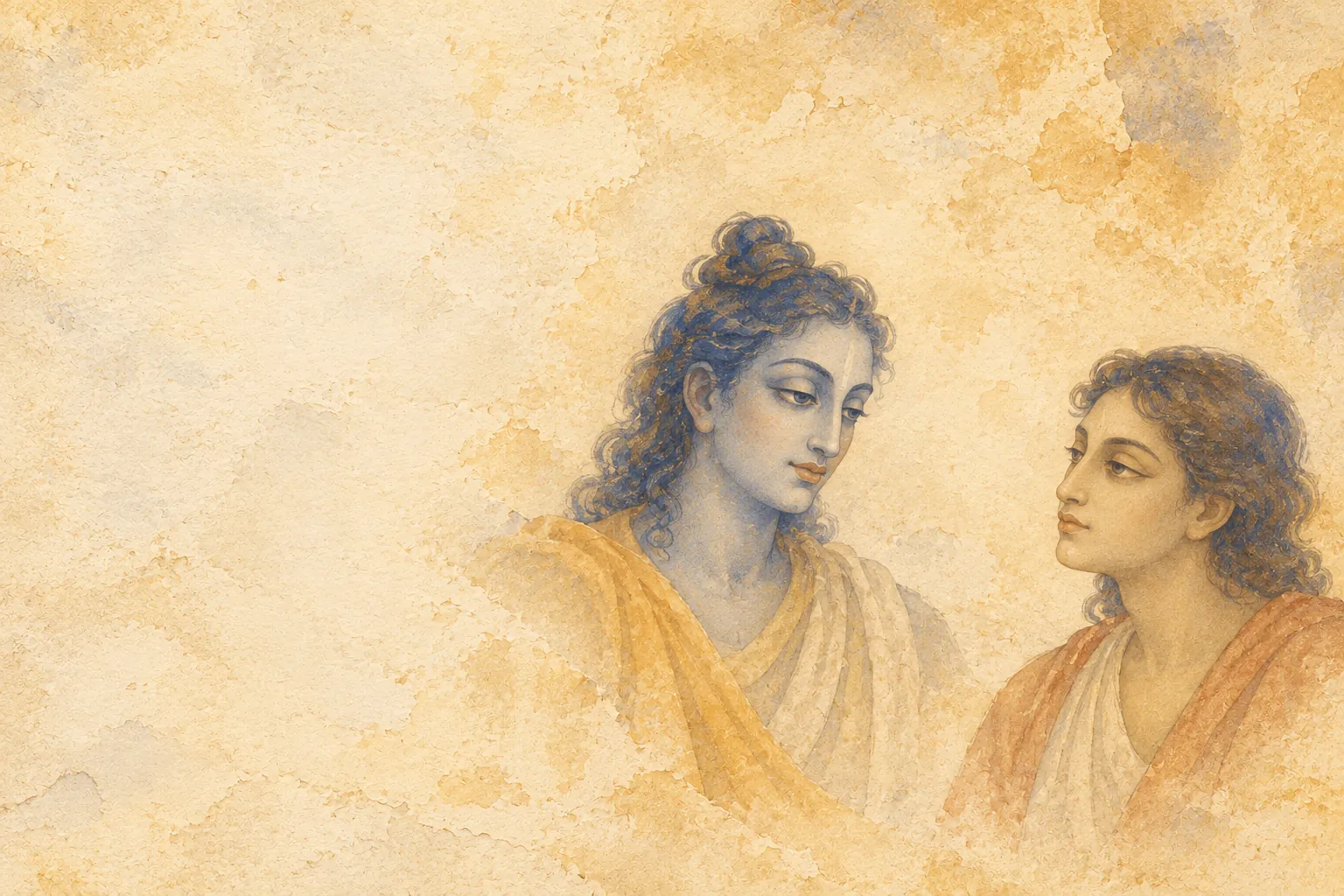
Between the two armies the Charioteer smiles, for he sees in the weeping man that which was never born and cannot be slain.
- viṣāda — the dejection in which every standard fails and the soul turns to the Friend
- brāhmī sthiti — the firm standing in the Brahman, where desire falls silent like the filled and motionless sea
The second chapter opens upon the ruin the first has left: a warrior invaded by pity, his eyes full and distressed with tears (2·1). The first answer is a rebuke, the answer of a hero to a hero, calling that mood a stain and darkness of the soul and bidding him shake off this paltry faintheartedness and arise (2·2–3). It is not compassion that is rebuked, as The Creed of the Aryan Fighter makes clear, but a weak self-pity that recoils from the suffering its own act must entail. And then the decisive turn is made, not by the Teacher but by the disciple. Confessing that his whole consciousness is bewildered in its view of right and wrong, Arjuna gives himself up: “I take refuge as a disciple with thee; enlighten me” (2·7). To this surrender Krishna answers first with a smile. Between the two armies, to the man depressed and discouraged, Hrishikesha speaks “smiling as it were” (2·10); and in that smile the whole delight of the Gita is folded, the ease of the Divine who sees the end in the beginning and has come not to judge the fallen soul but to lift it.
Not the Friend and Lover of man speaks first, but the guide and teacher who has to remove from him his ignorance of his true self and of the nature of the world and of the springs of his own action.
The first light therefore falls upon the intellect. “Thou grievest for those that should not be grieved for” (2·11): the enlightened man mourns neither the living nor the dead, because that which dwells in the body is unborn, ancient, sempiternal, and is not slain with the slaying of the body (2·20). This is the knowledge of the Sankhya, the discrimination of the immutable Self from the mutable workings of Nature, and it is given first because grief itself is an ignorance, a confusion of the soul with the perishable forms through which it passes. With it comes the humbler word of the warrior’s own law, svadharma, the work his nature and station have brought him; but neither the knowledge of immortality nor the rule of social duty is the Gita’s last reply, and both are at once taken up into something greater.
“Hear now this in the Yoga,” says the Teacher, and promises that by it the bondage of works shall be cast away (2·39); on this path no effort is lost, and even a little of it delivers from the great fear (2·40). This is the buddhiyoga, the Yoga of the intelligent will. The ordinary intelligence runs out in many branches after the desires that life offers it; the intelligence in Yoga is gathered, single, fixed in the Self and persistent in its decision. From this poise comes the first great formula of the Karmayoga: a right to action, but never to its fruits (2·47); and its secret is named at once, for it is equality that is meant by Yoga (2·48). The portrait of the man of stable understanding follows, the sthitaprajña, whose senses are drawn in as the tortoise draws in his limbs (2·58), in whom even the inner taste of desire ceases when the Supreme is seen (2·59), and who sits firm in Yoga, “wholly given up to Me” (2·61), three words in which, as Sri Aurobindo notes, the whole of the highest secret already lies in seed.
Equality is the great stamp of the liberated soul and of that equality even the most discernible signs are still subjective.
So the chapter ends in a vast stillness. He attains peace into whom all desires enter as waters into the sea, ever being filled and ever motionless (2·70); he who has no “I” or “mine” comes to the great peace (2·71); and this, says Krishna, is the brāhmī sthiti, the firm standing in the Brahman, from which there is no more bewilderment (2·72). The grief of the first chapter has been answered at its root. Yet the answer has opened a new difficulty, and Arjuna, the man of action, feels it at once: if the understanding is greater than works, if the goal is this silence in which desire falls away, why is he still bidden to a terrible work? The soul has found its footing in the Self. It has now to learn why the Self, so found, should act at all.
Essays on the Gita
- The Creed of the Aryan Fighter
- Sankhya and Yoga
- Sankhya, Yoga and Vedanta
- The Yoga of the Intelligent Will
Key verses
