ज्ञानकर्मसंन्यासयोगः
jñānakarmasaṃnyāsayogaḥ
He who descends into our birth descends that we may ascend into his; know his birth and his works, and your own become free.
- yajña — every work laid upon the altar as an offering to the Lord of works
- divyaṃ janma karma — the divine birth and the divine works, known in their truth
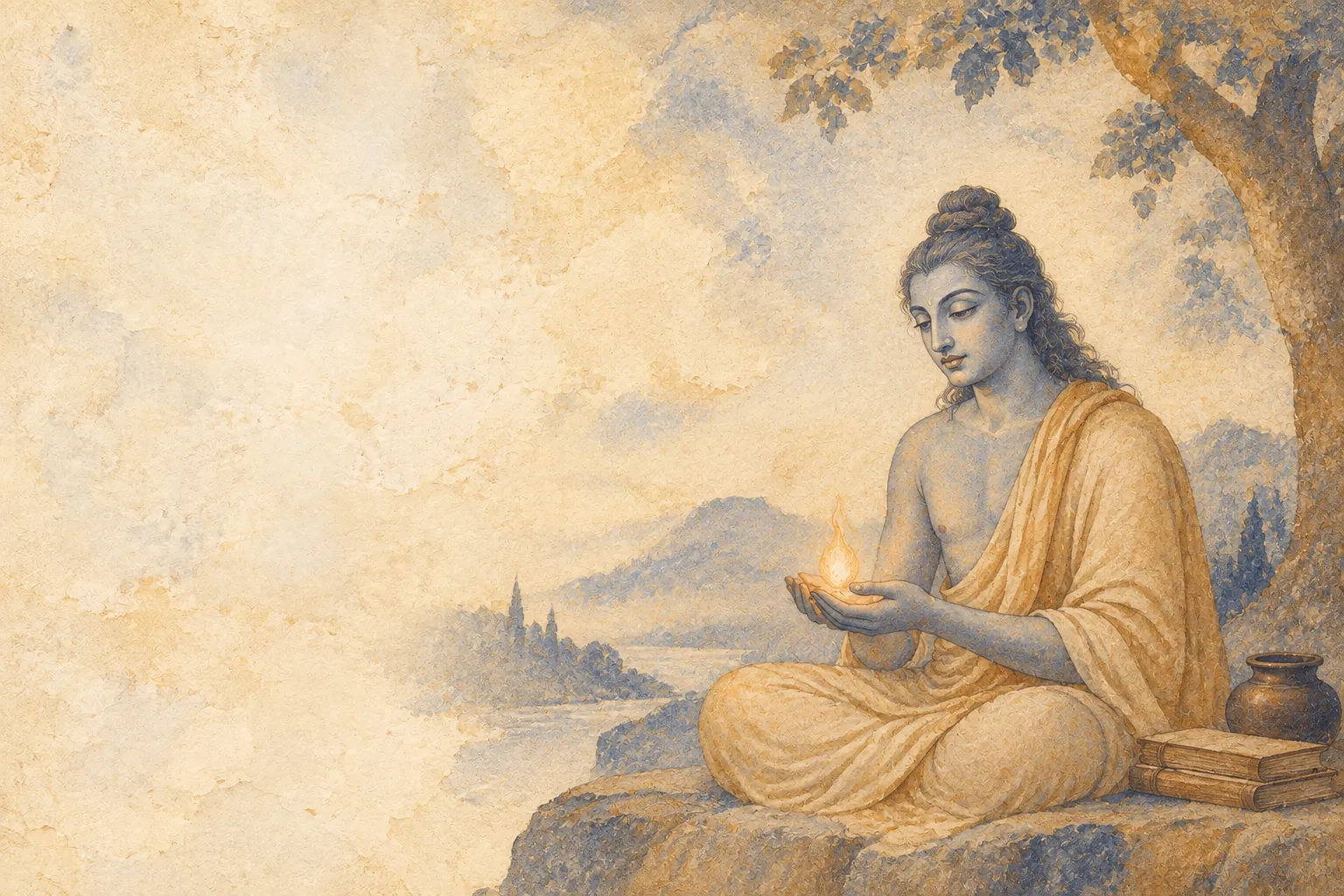
The soul has learned to offer its works, but it does not yet know to whom it offers them; and the fourth chapter begins by lifting the veil from the face of the companion in the chariot. This imperishable Yoga, Krishna says, I gave of old to Vivasvan, and Vivasvan to Manu, and Manu to Ikshvaku (4·1); it was lost by the long lapse of time, and now I declare it again to thee, because thou art my devotee and my friend (4·3). Arjuna, the practical man, is baffled: how can one born in his own day have spoken it in the beginning? His question, Sri Aurobindo remarks, provokes the famous declaration of Avatarhood. Though unborn, though imperishable in his self-existence, though the Lord of all existences, the Divine stands upon his own Nature and comes into birth by his self-Maya (4·6); whenever there is the fading of the Dharma he looses himself forth, and he is born from age to age for the deliverance of the good, the destruction of the evil-doers and the enthroning of the Right (4·7–8).
Yet the upholding of the Dharma, as The Possibility and Purpose of Avatarhood insists, is not the whole purpose of the descent. The Avatar comes to manifest the divine nature in the human nature, so that man may mould himself upon it and be transfigured; he stands at the centre of the way as its gate. His birth is not a fall into the Ignorance but the conscious birth of the Godhead in our humanity, and whoever knows in its true principles that divine birth and divine work comes, on leaving the body, not to rebirth but to him (4·9). Many, delivered from liking and fear and wrath, full of him, taking refuge in him, have already arrived at his nature of being (4·10); and to every seeker he turns with the same largeness: as men approach him, so he accepts them to his love (4·11).
It is the manifestation from above of that which we have to develop from below; it is the descent of God into that divine birth of the human being into which we mortal creatures must climb; it is the attracting divine example given by God to man in the very type and form and perfected model of our human existence.
From the divine birth the teaching passes to the divine works. Works do not stain the Lord, nor has he desire for their fruit, and he who knows him thus is not bound by works. The wise are bewildered to say what is action and what inaction; but he who can see inaction in action and action continuing in cessation from works is the man of true discernment, in Yoga, a many-sided universal worker (4·18). The liberated worker, content with whatever gain comes to him, equal in failure and success, is not bound even when he acts; his works, done for sacrifice, are dissolved and leave no trace upon the soul. Such works are the image in man of the Lord’s own working, and The Divine Birth and Divine Works gathers their character into a single sentence.
The Avatar comes to reveal the divine nature in man above this lower nature and to show what are the divine works, free, unegoistic, disinterested, impersonal, universal, full of the divine light, the divine power and the divine love.
Then sacrifice itself is widened until it fills the world. Brahman is the giving, Brahman the offering, by Brahman it is poured into the Brahman-fire (4·24); the many sacrifices, of the senses, of the breath, of self-discipline, of study, are ranged beside one another, and above them all stands the sacrifice of knowledge, in which all action culminates (4·33). Even the greatest of sinners shall cross over all the crookedness of evil in the ship of knowledge (4·36); as a kindled fire turns its fuel to ashes, so the fire of knowledge turns all works to ashes (4·37); and nothing in the world is equal in purity to knowledge (4·38). The chapter closes with a command in which the warrior and the seer are one: cut asunder with the sword of knowledge this doubt that abides in the heart, resort to Yoga, and stand up (4·42). The soul now knows that the Divine descends and works, and that works done in that knowledge are free; but it has still to learn how such freedom can live in the midst of action, and what renunciation truly is.
Essays on the Gita
- The Significance of Sacrifice
- The Principle of Divine Works
- The Possibility and Purpose of Avatarhood
- The Process of Avatarhood
- The Divine Birth and Divine Works
- The Divine Worker
- Equality and Knowledge
Key verses
